
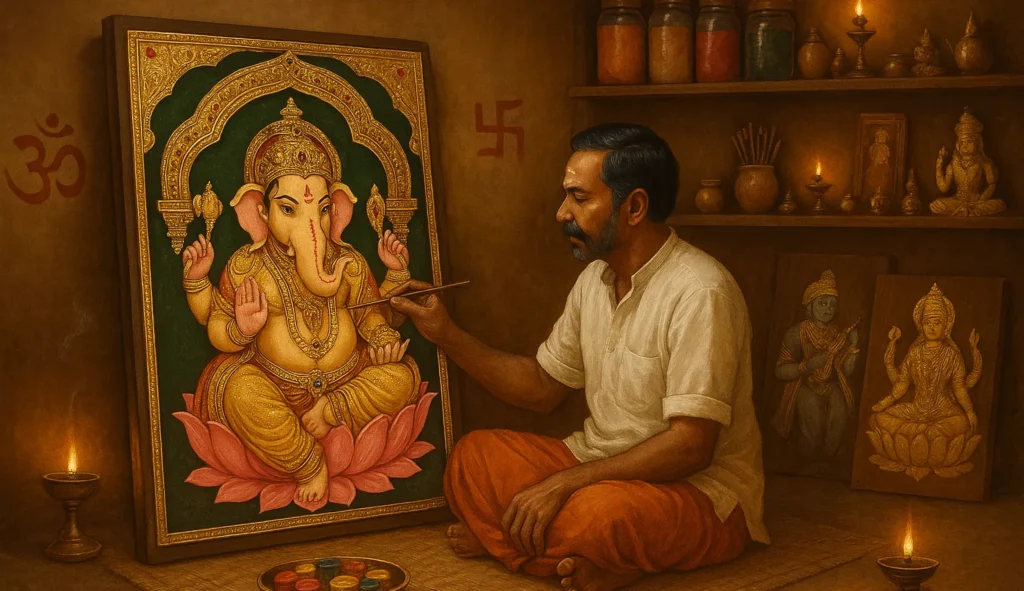
Tanjore paintings are a feast for the eyes – a harmonious blend of rich colors, intricate details, and the captivating shimmer of gold. But what exactly goes into creating these masterpieces? Beyond the artistic skill, the unique beauty of a Tanjore painting lies in the specific materials carefully chosen and meticulously applied by the artists. Let’s delve into the fascinating world of the raw materials that bring these sacred artworks to life.
Unlike many traditional Indian paintings that use cloth or paper, Tanjore paintings are traditionally crafted on a wooden plank (Palagai). This provides a sturdy and durable base, ensuring the longevity of the artwork. Commonly used woods include teakwood or plywood, chosen for their stability and ability to withstand the various layers of material applied.
Preparation: Before painting, the wooden plank is meticulously prepared. It’s often sanded smooth and then coated with a base layer of tamarind paste or Arabic gum mixed with chalk powder. This creates a fine, even surface for the subsequent layers and helps the paint adhere better.
One of the most distinguishing features of Tanjore paintings is the raised, three-dimensional effect achieved through gesso work, often referred to as “Muck Work.” This technique adds a sculptural quality to the deities’ ornaments, crowns, and architectural elements.
Materials: The gesso paste is traditionally made from a mixture of chalk powder (or lime powder) and a binding agent like Arabic gum (acacia gum) or tamarind seed paste. These ingredients are mixed to a thick, pliable consistency.
Application: The paste is carefully applied using a brush or a pointed tool to create the desired patterns and designs in relief. Once dry, the gesso hardens, providing a robust base for further embellishments.
The most iconic material in Tanjore paintings is undoubtedly the 22-carat gold foil. It’s the gold that gives these paintings their unparalleled brilliance and divine aura.
Quality: Using high-purity 22-carat gold ensures that the foil remains lustrous and doesn’t tarnish over time. Cheaper alternatives like gold leaf or synthetic gold paper are sometimes used in contemporary versions, but traditionalists adhere to pure gold for its longevity and spiritual significance.
Application: After the gesso work is complete and dry, a thin layer of adhesive (often shellac or a traditional gum adhesive) is applied to the raised areas. The delicate gold foil is then carefully laid over these areas and pressed firmly, ensuring it adheres smoothly to the contours of the relief work. The excess gold is then gently brushed away, revealing the shimmering design.
To further enhance the opulence and grandeur, Tanjore paintings are often adorned with a variety of semi-precious stones and colorful glass beads.
Variety: Commonly used stones include cabochon cut (unfaceted) rubies, emeralds, sapphires, and sometimes even uncut diamonds (polki), though these are rare in contemporary pieces due to cost. Red, green, and white stones are particularly popular.
Glass Beads: Vibrant glass beads in various colors and shapes are also extensively used, offering a more affordable yet equally sparkling alternative to precious stones.
Placement: These stones and beads are meticulously set into the gesso work, often within the gold foil, to represent jewelry, clothing embellishments, and decorative motifs.
The vibrant hues of Tanjore paintings are a result of carefully chosen pigments. Traditionally, artists sourced and prepared their own natural pigments from minerals, plants, and other organic materials.
Traditional Pigments:
Red: Vermilion (sindoor), cochineal
Blue: Indigo, lapis lazuli
Green: Malachite, greens from plant extracts
Yellow: Turmeric, ochre
White: Zinc oxide, chalk powder
Black: Lamp black (soot)
Modern Adaptation: While some traditional artists still prefer natural pigments, the time-consuming process of preparation has led many contemporary artists to use high-quality poster colors or acrylic paints. These offer a wide spectrum of colors, good lightfastness, and ease of use, without significantly compromising the aesthetic appeal when applied skillfully. The colors are applied in multiple layers to achieve depth and richness.
To bind the pigments and provide a protective layer, Arabic gum (acacia gum) is often used as a medium, especially with traditional pigments.
Varnish: Finally, after the painting is complete and dry, a layer of varnish (such as shellac varnish) is applied. This serves several purposes:
Protection: It protects the painting from dust, moisture, and environmental damage.
Enhancement: It intensifies the colors and adds a subtle sheen, making the gold foil and embellishments stand out even more.
The creation of a Tanjore painting is a testament to the artist’s dedication, patience, and mastery over these diverse materials. Each component, from the humble wooden plank to the shimmering gold foil, plays a crucial role in shaping the final masterpiece. The meticulous selection and application of these materials are what elevate Tanjore paintings from mere pictures to timeless works of art, radiating beauty, devotion, and a profound connection to India’s rich cultural heritage.

